

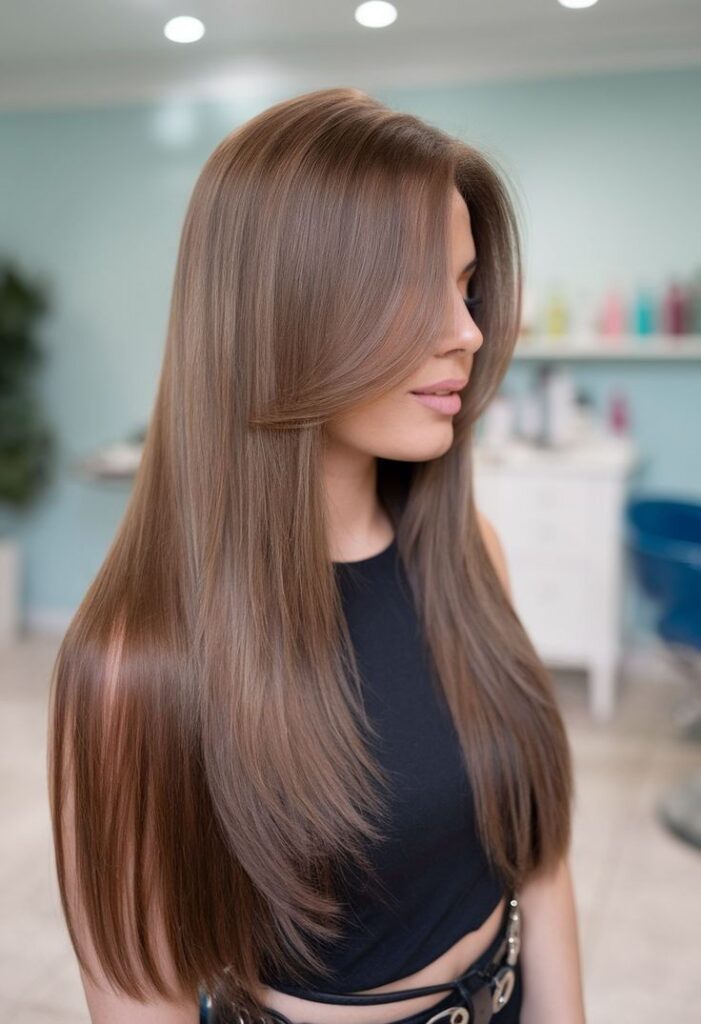
Bangalore is one of the highest keratin treatment markets in India — and if you’ve ever spent a morning getting your blowout right only to have it completely undone by the humidity between your apartment and your office, you already know why. But the questions most people have before booking aren’t about whether to do it. They’re about what it should cost, what that cost actually covers, and whether two salons quoting different prices are offering the same thing. They’re usually not.
What a Keratin Treatment Actually Does
A keratin treatment works by infusing a protein-based solution into the hair shaft, then sealing it using controlled heat from a flat iron. The protein bonds with the hair’s existing keratin structure and the heat seals the cuticle — the outermost layer of each strand — into a flat, smooth configuration.
Flat cuticles mean less frizz (because the rough, raised surfaces that catch humidity are eliminated), more shine (because light reflects off a flat surface more uniformly than an irregular one), and significantly better manageability in Bangalore’s variable humidity.
What it does not do: it does not permanently straighten your hair (that’s a chemical relaxer, which is a different category of treatment), it does not repair split ends (no treatment does — split ends can only be cut), and it does not change your hair’s natural wave or curl pattern permanently. It manages how that pattern behaves, for 3-5 months.
What Drives the Price Difference in Bangalore
Hair length and density
This is the primary variable. Short hair uses a fraction of the product that waist-length hair requires. Most reputable salons price in four length tiers: above the shoulder, shoulder to collarbone, collarbone to mid-back, and mid-back to waist-plus. Always quote your actual length and density — fine short hair and thick short hair are different propositions.
Product quality and origin
The Indian market has a wide range of keratin products, from imported Brazilian and Japanese professional formulas to domestically manufactured alternatives. The difference matters for longevity. A professional-grade import used at Bellance Salon Whitefield should last 3-5 months in Bangalore’s conditions. If you are comparing options and looking for the best hair salon in Whitefield Bangalore for keratin treatment, product quality and stylist experience should be considered alongside price. A cheaper domestic alternative may deliver similar initial results but fade significantly within 6-8 weeks. The cost per month of lasting results often favours the premium product.
Application technique and stylist experience
The flat-iron sealing stage is technically demanding. The temperature must be precise — too low and the cuticle doesn’t fully seal, leaving the treatment underperforming; too high and the heat itself damages the hair structure you’re trying to protect. The number of passes per section, the tension maintained during ironing, and the processing time between application and sealing all affect the outcome. This is why stylist experience matters as much as product quality.
What’s included in the package
Some keratin packages include a trim, a professional blowout, and a post-treatment oiling; others quote the treatment only. Always confirm what’s included before comparing price between salons. One important note for Bangalore clients: many people do a balayage colour service first, then follow up with a keratin treatment two to three weeks later. Keratin seals the cuticle after balayage, extending colour vibrancy and adding shine — one of the most effective combinations for coloured hair in Bangalore’s humidity. If you are planning both balayage and keratin, discuss the sequence at your Bellance consultation before booking.
Keratin vs Nanoplastia vs Smoothening — The Question Everyone Asks
These three treatments are frequently conflated, but they’re meaningfully different in mechanism, result, and appropriate use case.
Keratin treatment uses protein infusion sealed with heat to control frizz and add shine. The hair retains its natural wave or curl pattern but behaves more smoothly. This is the baseline treatment — well-understood, widely available, predictable results.
Nanoplastia is a newer formulation that works at a finer molecular level, using nano-sized particles of keratin, collagen, amino acids, and sometimes biotin. The result looks more natural than traditional keratin — the hair behaves better without the occasionally artificial ‘too-straight’ quality some clients find with older formulations. Hair condition also improves more noticeably. Lasts 4-6 months. Slightly higher investment, genuinely different result.
Smoothening is a broader term that often describes a mild chemical process — closer to a light relaxer than a keratin treatment. It delivers straighter results but involves more chemical intervention than keratin. The two are not interchangeable, and if a salon quotes you for ‘smoothening’ when you asked for ‘keratin,’ ask specifically what they mean.
At Bellance in Bangalore, we recommend keratin for clients primarily seeking frizz control with texture retained, and nanoplastia for clients who want the conditioning improvement and a more refined, natural result with longer longevity.
| Bharat Singh, Technical Director, Bellance Salon: “One thing I always ask new clients before their keratin appointment is whether they’ve been using a water softener at home. Bangalore’s municipal supply is hard water, and clients who have been washing their hair exclusively in hard water for years often have mineral buildup on the hair shaft that actually interferes with keratin bonding. In those cases, we do a chelating wash first — it adds about 20 minutes but the treatment penetrates and lasts significantly better. It’s a detail that makes a real difference to the outcome.” |
What to Expect on the Day
A full keratin treatment at Bellance hair salon Whitefield takes 2.5 to 3.5 hours depending on hair length and density. The sequence: clarifying shampoo (removes all oil, product, and buildup) — application of keratin solution in sections — 20-30 minute processing — blow dry — flat iron sealing — finishing treatment. You leave with immediately different hair.
The first 48-72 hours are critical: no washing, no tying the hair, no tucking behind the ears. After this window, the treatment has fully set and you can wash and style normally. We’ll give you specific aftercare instructions and product recommendations for Bangalore conditions before you leave.
| Frequently Asked Questions |
| Q: How long does keratin treatment last in Bangalore? A: 3-5 months with a quality product and correct application. Using sulphate-free shampoo, avoiding chlorinated water, and not overwashing extends the result. Bangalore’s moderate humidity is actually less damaging to keratin results than Mumbai or Chennai. |
| Q: Can I colour my hair before or after a keratin treatment? A: Both are possible — the sequence matters. If you’re doing both in the same visit, colour first, then keratin. The keratin seals the colour in and extends vibrancy. If doing them on separate occasions, wait at least two weeks between appointments. Never do them back-to-back on the same day. |
| Q: Is keratin safe for previously coloured or highlighted hair? A: Yes, and it often improves the condition and longevity of colour. The keratin seals the cuticle, which reduces the porosity that makes coloured hair prone to fading and dryness. At Bellance we use formulations appropriate for chemically treated hair — always mention your colour history at your consultation. |
| Q: What’s the difference between a hair spa and keratin treatment? A: Completely different categories. A hair spa is a conditioning treatment that improves the feel and moisture of your hair for 2-4 weeks. A keratin treatment structurally changes how your hair behaves for 3-5 months by sealing the cuticle. You should ideally have regular hair spas to maintain hair health alongside periodic keratin treatments — they’re complementary, not alternatives. |
| Q: How do I book a keratin treatment at Bellance Salon Bangalore? A: Book at bellancesalon.com/booking/ or call +91-95-4059-4059. We’re in Whitefield (Sumadhura Capitol Towers), making Bellance a convenient salon in Whitefield for clients looking for transparent, length-based keratin pricing with no hidden charges. We also have a location in Indiranagar (2964, 12th Main, HAL 2nd Stage). |